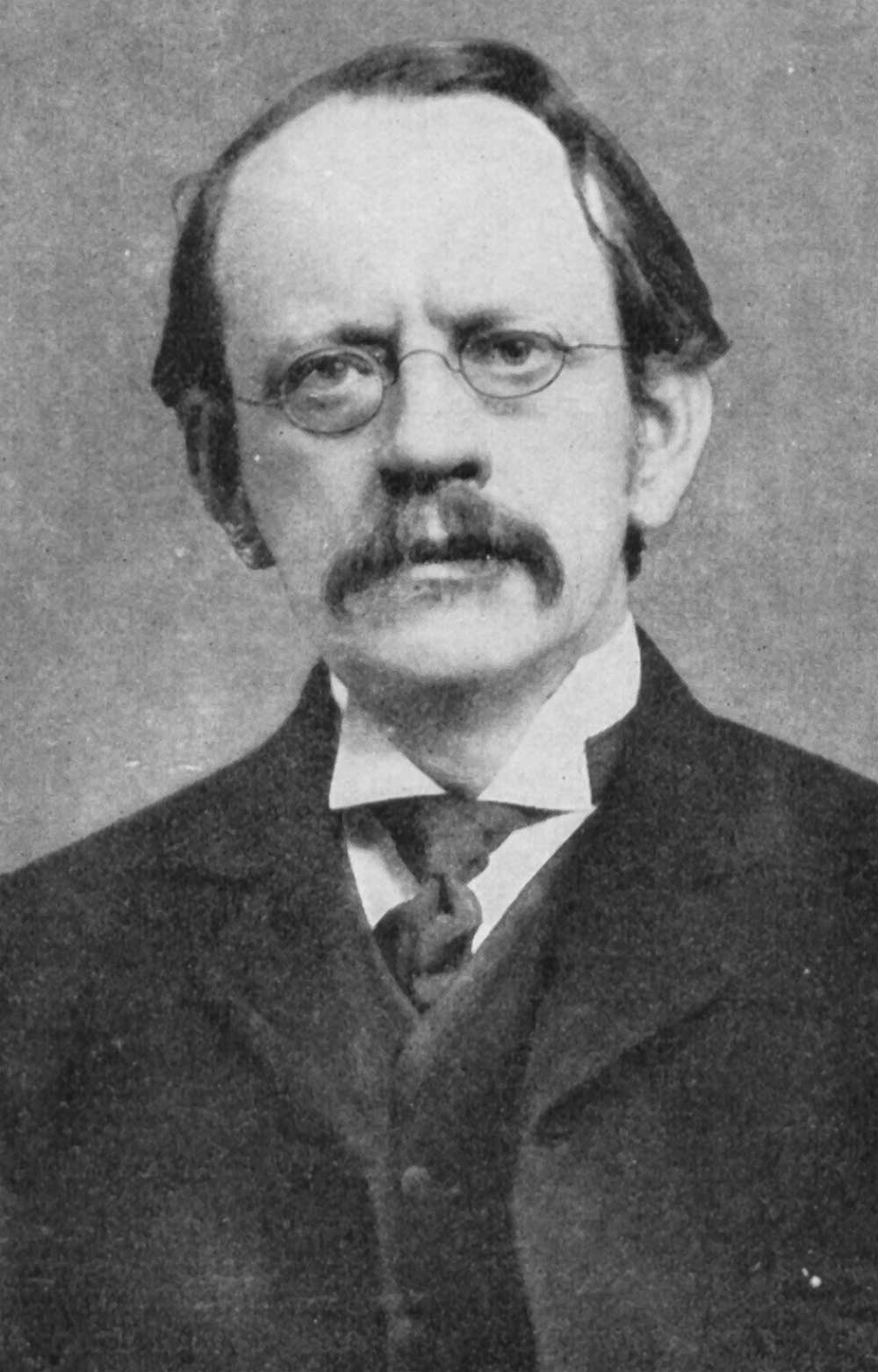
J.J. Thomson: British physicist (1856–1940) (Source: Wikipedia)
For most of the 19th century, John Dalton’s model of a hard, indivisible sphere, a scientific update to the ancient philosophy of Democritus, dominated chemistry. The first evidence to challenge this picture came not from chemistry, but from physics and the study of mysterious “cathode rays,” beams that emanated from the negative electrode (the cathode) in a vacuum tube. Was their true nature a form of light, or streams of particles? In 1897, British physicist J.J. Thomson definitively solved this debate, and in doing so, characterized these rays as negatively charged particles far smaller than any known atom.
J.J. Thomson: British physicist (1856–1940) (Source: Wikipedia)
Using a cathode ray tube, a sealed glass tube with most of the air pumped out to a near-vacuum, he generated the rays by applying a high voltage across the electrodes. The resulting beam of particles was shaped and accelerated by passing through two metal anodes, which acted as collimators. Thomson observed that these rays could be deflected (their path bent) by an electric field, proving they were not light but were composed of negatively charged particles. This is known as the Cathode Ray Tube Experiment.
Explore the core principle of his experiment yourself with the interactive diagram below.
The simulation shows a beam of particles emitted from the cathode on the left. This beam travels in a straight line through a vacuum until it strikes the fluorescent screen at the far right, creating a glowing dot. The key to the experiment lies in manipulating this beam.
Controlling the Deflection: Use the slider labeled Deflection Voltage (V) to apply an electric field across the two plates. As you increase the voltage, the electric field gets stronger. Notice how the amount the beam bends is directly proportional to the voltage you apply. A stronger field causes a greater deflection. Setting the voltage to zero turns the field off, and the beam once again travels in a straight line.
Observing the Charge: The beam always bends toward the positive (+) plate and away from the negative (−) plate. This is the crucial piece of evidence showing the particles must have a negative charge. Click the Reverse Polarity button to flip the charges on the plates. As you would expect, the beam immediately deflects in the opposite direction, always seeking the positive charge.
Beyond identifying the negative charge, Thomson’s quantitative measurements, detailed in his 1897 paper, led to his key discovery. He determined the particle’s charge-to-mass ratio (e/m), a fundamental property that serves as a unique identifier for charged particles. A particle with a very large e/m ratio must either carry an enormous charge or possess an exceptionally small mass.
Thomson’s measured value was striking: approximately 1.7 × 10¹¹ C kg−1, roughly 1,800 times larger than the charge-to-mass ratio of the hydrogen ion (9.6 × 10⁷ C kg−1), the lightest known particle at the time. This enormous difference pointed to two possibilities: either the cathode ray particle carried 1,800 times more charge than hydrogen, or it was 1,800 times lighter. Thomson reasoned that the former was implausible. Chemical evidence suggested that atoms and ions carry similar magnitudes of charge, making it far more likely that this particle was extraordinarily light rather than extraordinarily charged. His conclusion: he had discovered a subatomic particle with a mass far smaller than any atom.
The modern accepted value for the electron’s charge-to-mass ratio is 1.75882001076(53) × 1011 C kg−1 (CODATA 2022), demonstrating that Thomson’s 1897 measurement was remarkably accurate given the technology of his time.
To find the e/m ratio, Thomson performed a brilliant two-step experiment using the same tube. He first applied only a known electric field (E) and measured the beam’s deflection. Then, in the same region, he applied a magnetic field (B), oriented to bend the beam in the opposite direction. He carefully adjusted the magnetic field’s strength until the magnetic force perfectly canceled the electric force, and the beam once again traveled in a perfectly straight line.
Let’s examine the physics behind each step. When the forces are balanced, the electric force must equal the magnetic force:
\[ eE = evB \]
He could solve for the particle’s velocity (v), as the charge e cancels from both sides:
\[ v = \frac{E}{B} \]
With the velocity (v) now known, Thomson could analyze the original deflection caused by the electric field alone. While an electron is between the plates, it experiences a constant vertical force, causing it to accelerate vertically. This vertical acceleration (a_y) is given by Newton’s second law:
\[ a_y = \frac{F_E}{m} = \frac{eE}{m} \]
The total vertical deflection depends on this acceleration and the time (t) the electron spends between the plates. The time is simply the length of the plates (L) divided by the particle’s horizontal velocity (v). By substituting these relationships into the standard kinematic equations of motion, the vertical deflection (y) can be expressed as:
\[ y = \frac{1}{2} a_y t^2 = \frac{1}{2} \left( \frac{eE}{m} \right) \left( \frac{L}{v} \right)^2 \]
Since Thomson could measure the deflection (y) and knew the apparatus dimensions (L), the electric field strength (E), and now the velocity (v), the only unknown left in the equation was the charge-to-mass ratio, e/m.
The value he determined was approximately 1.7 × 10¹¹ C kg−1.
Crucially, he found that these particles were identical regardless of the metal he used for the cathode. He concluded that these negative particles, which he called “corpuscles” and we now call electrons, must be a fundamental component of all atoms. The term “electron” was proposed by Irish Physicist George Johnstone Stoney in 1891 (before Thomson’s discovery) to name the fundamental unit of electric charge. Thomson initially used “corpuscle” but “electron” eventually won out. For this groundbreaking work, Thomson was awarded the Nobel Prize in Physics in 1906.
This discovery disproved the old model of the atom as a hard, indivisible sphere. First, by showing that he could extract a particle that was thousands of times lighter than a hydrogen atom, Thomson proved that atoms were not indivisible: they had smaller parts. Second, the discovery of a negative particle from a neutral atom proved that atoms must also contain a positive charge. The featureless sphere was gone, replaced by an object with an internal structure.
To account for these new facts, Thomson proposed the first testable model of an atom, the Plum Pudding Model (1904), which pictured a diffuse sphere of positive charge with tiny, lightweight electrons dotted throughout it, like plums in a pudding. The positive charge was envisioned as diffuse rather than concentrated because the electrons were so small and light. Thomson reasoned that most of an atom’s mass must come from the positive portion, which would therefore occupy most of the atom’s volume.
While J.J. Thomson discovered the electron and determined its charge-to-mass ratio (e/m), a crucial question remained unanswered: what were the individual values of the electron’s charge (e) and its mass (m)? Knowing the ratio alone was insufficient; once either value was known, the other could be calculated through simple division, providing a complete picture of this new fundamental particle.
American physicist Robert Millikan tackled this challenge starting in 1908.

Robert Millikan: American physicist (1868–1953) (Source: Wikipedia)
His experiment was conceptually simple but experimentally demanding. He constructed a chamber containing two horizontal, parallel brass plates. A fine mist of clock oil from an atomizer was sprayed into an upper chamber. Oil was used because of its very low evaporation rate, ensuring a droplet’s mass would remain constant during an observation. Using a specially mounted microscope, he could select and observe a single droplet as it fell through a pinhole into the space between the plates. The air in the chamber was then ionized, typically using X-rays, causing free electrons or ions to stick to the oil drops and give them a net negative charge. This is known as the Oil Drop Experiment.

Oil Drop Experiment: Diagram of the experimental setup in Millikan’s original 1913 paper. (Source: Wikipedia)
The interactive simulation below demonstrates the delicate balancing act.
By meticulously observing thousands of droplets, Millikan confirmed that the charge on them was indeed quantized, meaning charge exists only in discrete, indivisible packets rather than continuous values. While the suspension method is easiest to visualize, his most precise measurements came from a more dynamic “rise-and-fall” method. In this approach, he measured the terminal velocity of a drop falling under gravity alone (field off), which allowed him to calculate the drop’s mass through Stokes’ law. He then applied a powerful electric field and measured the drop’s velocity as it rose upward. By comparing these two velocities—one determined purely by gravity and air resistance, the other by the balance of electric force, gravity, and air resistance—he could calculate the charge with greater accuracy while also accounting for the ever-present jostling from air molecules (Brownian motion).
In his seminal 1913 paper, Millikan concluded that the charge on any drop was always an integer multiple (1, 2, 3,…) of a single, fundamental value. This smallest packet of charge, he reasoned, must be the charge of a single electron. The underlying physics that allowed him to calculate the charge of a single electron is elegant in its simplicity.
The experiment is a contest between two forces acting on a single oil drop: the constant downward pull of gravity and the adjustable upward pull of the electric force.
The Force of Gravity (Fg) is determined by the drop’s mass (m) and the gravitational acceleration (g): \[ F_\mathrm{g} = mg \] The most difficult part of the real experiment was accurately determining the tiny mass of each droplet, which Millikan did by measuring its rate of fall without an electric field.
The Electric Force (FE) is determined by the total charge on the drop (q) and the strength of the electric field (E). For a uniform field between two parallel plates, the electric field strength is the electric potential difference (or voltage, V) applied across the plates divided by the distance (d) between them. \[ F_{\mathrm{E}} = qE = \frac{qV}{d} \]
where E is the electric field strength (V m−1), q is charge (C), V is voltage (V), and d is plate separation (m).
When a drop is perfectly suspended, the forces are balanced: \[ F_{\mathrm{g}} = F_{\mathrm{E}} \] \[ mg = \frac{qV}{d} \]
By rearranging the equation, Millikan could solve for the total charge q on any suspended droplet, since all other values were known or measured: \[ q = \frac{mgd}{V} \]
The value Millikan reported for this fundamental charge in his 1913 paper was 1.592 × 10⁻¹⁹ C. Since the 2019 redefinition of SI units, the elementary charge is defined exactly as e = 1.602 176 634 × 10−19 C (CODATA 2022). Millikan’s result was off by less than 1%, a remarkable achievement that rightfully earned him the Nobel Prize in Physics in 1923.
Robert Millikan’s oil drop experiment earned him the 1923 Nobel Prize in Physics for providing the definitive measurement of the electron’s charge.
However, the story behind the number is far more complex and human than it first appears. A closer look reveals a fascinating history of subtle biases, the selective use of data, and a long-lasting impact on other scientists who struggled for years under the weight of his authority.
To explore this compelling story of scientific integrity, confirmation bias, and how the scientific community slowly corrects its course, see The Weight of a Number: Robert Millikan and the Charge of Scientific Integrity.
With the electron and its properties established, the next great mystery was understanding the rest of the atom’s structure.