Lewis Structures
In the previous chapter, we covered how electrons are arranged within isolated atoms through electron configurations. Now we turn to what happens when atoms come together to form molecules and ions. In 1916, American chemist Gilbert N. Lewis proposed that atoms form bonds by sharing pairs of electrons. Lewis structures are diagrams based on this idea. They show how valence electrons are distributed in a molecule, including both the electrons shared in chemical bonds and the electrons that remain as lone pairs. They are the primary tool for predicting molecular geometry using VSEPR theory.
Lewis Dot Symbols
A Lewis dot symbol represents the valence electrons of an atom as dots arranged around its chemical symbol. Each dot is one valence electron. Dots are placed on four sides of the symbol (top, bottom, left, right), one dot per side first. Once all four sides have a single dot, additional electrons are paired up on the sides until all valence electrons are represented.
The number of valence electrons follows directly from the group number for main group elements:
Noble gases (Group 18), with the exception of helium, have eight valence electrons. This full set of eight is called an octet, and it corresponds to a completely filled valence shell. The octet rule states that main group atoms tend to form bonds in such a way that each atom achieves eight electrons in its valence shell, mimicking the electron configuration of the nearest noble gas. This number, eight, reflects the electron capacity of the valence shell.
NoteWhere does the number eight come from?
Each orbital holds at most two electrons. The number of orbitals in a valence shell determines how many electrons it can hold:
The octet rule reflects the fact that main group valence shells contain four orbitals with a combined capacity of eight.
Transition metals also have d orbitals available for bonding (five per subshell), giving a total of nine valence orbitals and a capacity of 18. The resulting 18-electron rule operates on different principles and is covered in coordination chemistry courses.
Lanthanides and actinides have f orbitals (seven per subshell), but f orbitals vary widely in how much they contribute to bonding. Some participate meaningfully (especially in early actinides like uranium), while others are too contracted to interact with neighboring atoms.
Orbital capacity explains why the numbers are 2, 8, and 18. Why atoms tend to fill their valence shells is a separate question, grounded in the energy gap between filled shells and the next available orbitals.
Hydrogen and helium are exceptions. Their valence shell is the n = 1 shell, which contains just one orbital and holds a maximum of two electrons. The duplet rule states that hydrogen and helium achieve stability with two valence electrons.

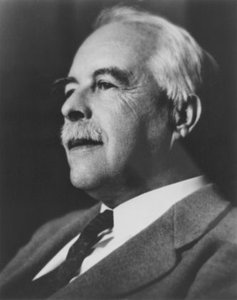
Gilbert N. Lewis: American physical chemist (1875–1946) (Source: Wikipedia)
Chemical Bonds
A chemical bond is a lasting attraction between atoms that enables the formation of molecules and compounds. Two types are most relevant to Lewis structures, depending on whether electrons are shared or transferred. (A third type, metallic bonding, involves delocalized electrons shared across many atoms and is not represented by Lewis structures.)
Covalent Bonds
A covalent bond forms when two atoms share one or more pairs of electrons. Both atoms contribute electron density to the region between them, and the shared electrons are attracted to both nuclei simultaneously. This dual attraction is what makes the bonded state lower in energy than the separated atoms. Bonds form because sharing electrons is energetically favorable. The octet pattern is a consequence, not the driving force.
The number of shared pairs determines the bond type:
- A single bond consists of one shared electron pair and is drawn as a single line between atoms.
- A double bond consists of two shared electron pairs and is drawn as two parallel lines.
- A triple bond consists of three shared electron pairs and is drawn as three parallel lines.
Each line in a Lewis structure represents two electrons.
Hydrogen (H2) provides the simplest example. Each hydrogen atom has one valence electron. By sharing their electrons, both atoms achieve a duplet.
Oxygen (O2) requires a double bond. Each oxygen has six valence electrons. Sharing two pairs gives both atoms an octet.
Nitrogen (N2) requires a triple bond. Each nitrogen has five valence electrons. Sharing three pairs gives both atoms an octet.
Not all electron pairs are involved in bonding. A lone pair (or non-bonding pair) is a pair of valence electrons that belongs to a single atom and is not shared. Lone pairs are drawn as pairs of dots on the atom.
Fluorine (F2) illustrates both bonding and lone pairs clearly. Each fluorine has seven valence electrons. One pair is shared in a single bond, and each fluorine retains three lone pairs, giving both atoms an octet.
The examples above follow a “dots-first” approach: start with valence electrons on each atom, pair up unpaired electrons to form bonds, and leave the rest as lone pairs. This is close to how Lewis himself reasoned in his original paper2, where he represented bonds as shared electrons between atoms rather than as lines. The same approach extends to polyatomic molecules.
The standard procedure introduced later in this chapter takes a different starting point. Rather than building bonds from dot symbols, it begins with a bonding skeleton and fills in electrons afterward. Both methods produce the same final structures.
Ionic Bonds
An ionic bond results from the transfer of one or more electrons from one atom to another, producing oppositely charged ions that attract each other. Ionic bonds typically form between metals (low ionization energy, readily lose electrons) and nonmetals (high electron affinity, readily gain electrons).
In sodium chloride (NaCl), sodium transfers its single valence electron to chlorine. The resulting Na+ and Cl− ions are held together by electrostatic attraction. Each ion has a noble gas electron configuration.
The degree to which bonding electrons are shared or transferred depends on the electronegativity difference between the atoms. This continuum from nonpolar covalent to ionic bonding is explored in detail in Bond Properties.
Drawing Lewis Structures
Drawing Lewis structures follows a systematic procedure. With practice, many of these steps become automatic, but working through them carefully produces correct structures for unfamiliar molecules.
Step 1. Count the total number of valence electrons. For polyatomic ions, add one electron for each unit of negative charge and subtract one electron for each unit of positive charge.
Step 2. Place the central atom. This is usually the least electronegative atom but never hydrogen.
TipIdentifying the central atom
- The central atom is usually the least electronegative atom, but hydrogen is never central.
- Hydrogen and halogens are almost always terminal atoms because they form only one bond.
- Carbon, nitrogen, phosphorus, and sulfur are commonly central atoms.
- In molecular formulas like H2O or NH3, the atom written first (if not H) is often the central atom.
- Oxygen is the central atom in water but is terminal in most other compounds.
Step 3. Place the remaining atoms around the central atom. Draw a single bond from each terminal atom to the central atom.
Step 4. Distribute the remaining electrons as lone pairs. Start with the terminal atoms, giving each an octet (or duplet for hydrogen). Place any leftover electrons on the central atom.
Step 5. Check the central atom. If it has fewer than 8 electrons, convert one or more lone pairs from a terminal atom into bonding pairs (forming double or triple bonds) until the central atom achieves an octet.
Step 6. If the species is an ion, enclose the entire Lewis structure in square brackets and write the charge as a superscript outside the bracket.
Example: Water (H2O)
Step 1. Count valence electrons.
- O: 6 ve−
- 2 H: 2 × 1 = 2 ve−
- Total: 8 ve−
Step 2. Oxygen is the central atom (H is always terminal). Draw single bonds to each hydrogen.
This accounts for 4 of the 8 valence electrons (2 bonds × 2 e− per bond).
Step 3. Distribute remaining electrons. There are 4 electrons left. Hydrogen already has a duplet from the bond, so all 4 remaining electrons go on oxygen as 2 lone pairs.
Step 4. Check octets. Oxygen has 8 electrons (2 bonding pairs + 2 lone pairs). Each hydrogen has 2 electrons (duplet). All atoms have complete octets (or duplets for hydrogen).
Step 5. Water is neutral, so no brackets are needed.
The final Lewis structure shows oxygen with two single bonds to hydrogen and two lone pairs.
Example: Formaldehyde (CH2O)
Step 1. Count valence electrons.
- C: 4 ve−
- 2 H: 2 × 1 = 2 ve−
- O: 6 ve−
- Total: 12 ve−
Step 2. Carbon is the central atom (least electronegative non-hydrogen atom). Draw single bonds to H, H, and O.
This accounts for 6 of 12 electrons (3 bonds × 2 e−).
Step 3. Distribute remaining electrons. There are 6 electrons left. Each H already has a duplet. Place all 6 remaining electrons on oxygen as 3 lone pairs.
Step 4. Check the central atom. Carbon currently has only 6 electrons (three single bonds). It needs 2 more to complete its octet. Convert one lone pair on oxygen into a second bonding pair, forming a C=O double bond.
Now carbon has 8 electrons (two single bonds + one double bond) and oxygen has 8 electrons (one double bond + two lone pairs). Each hydrogen has a duplet.
Step 5. Formaldehyde is neutral, so no brackets are needed.
Example: Hydrogen Cyanide (HCN)
Step 1. Count valence electrons.
- H: 1 valence e−
- C: 4 valence e−
- N: 5 valence e−
- Total: 10 valence e−
Step 2. Carbon is the central atom (less electronegative than nitrogen; hydrogen is terminal). Draw single bonds to H and N.
This accounts for 4 of 10 electrons.
Step 3. Distribute remaining electrons. There are 6 electrons left. Hydrogen already has a duplet. Place all 6 remaining electrons on nitrogen as 3 lone pairs.
Step 4. Check the central atom. Carbon currently has only 4 electrons (two single bonds). It needs 4 more to complete its octet. Convert two lone pairs on nitrogen into bonding pairs, forming a C≡N triple bond.
Now carbon has 8 electrons (one single bond + one triple bond), nitrogen has 8 electrons (one triple bond + one lone pair), and hydrogen has a duplet.
Step 5. HCN is neutral, so no brackets are needed.
Practice
Draw the Lewis structure for carbon dioxide (CO2).
Solution
Step 1. Count valence electrons.
- C: 4 valence e−
- 2O: 2 × 6 = 12 valence e−
- Total: 16 valence e−
Step 2. Carbon is the central atom. Draw single bonds to each oxygen.
This accounts for 4 of 16 electrons.
Step 3. Distribute remaining electrons (12 left). Place 6 electrons on each oxygen as 3 lone pairs.
All 16 electrons are now placed.
Step 4. Check the central atom. Carbon has only 4 electrons (two single bonds). It needs 4 more. Convert one lone pair from each oxygen into a bonding pair, forming two C=O double bonds.
The final structure has two C=O double bonds and two lone pairs on each oxygen:
Carbon has 8 electrons (two double bonds). Each oxygen has 8 electrons (one double bond + two lone pairs). All formal charges are zero, which we will verify when formal charges are introduced in the next section.
Formal Charge
When drawing Lewis structures, you may find that more than one valid arrangement of atoms and bonds is possible for a given molecular formula. Formal charge is a bookkeeping tool that helps determine which arrangement is the best representation of the actual molecule. It splits bonding electrons equally between atoms, then checks whether each atom “owns” more or fewer electrons than it would as a free atom. A formal charge of zero means the atom has exactly its expected count.
The formal charge on an atom in a Lewis structure is defined as:
\[\mathrm{FC} = \underset{\small \mathrm{free~atom~~~~~~~~}}{\mathrm{valence}~{e^-}} ~-~ \mathrm{nonbonding}~{e^-} ~-~ \tfrac{1}{2}\mathrm{(bonding}~{e^-)}\]
An equivalent and often faster way to calculate formal charge is:
\[\mathrm{FC} = \underset{\small \mathrm{free~atom~~~~~~~~}}{\mathrm{valence}~{e^-}} ~-~ \mathrm{dots} ~-~ \mathrm{lines}\]
where “dots” is the number of lone pair electrons on the atom and “lines” is the number of bonds to the atom (each line represents 2 bonding electrons, and half of 2 is 1).
ImportantFormal charge is not actual charge
The formal charge formula assumes bonding electrons are shared equally (50/50) between atoms. In real molecules, sharing is almost never perfectly equal. Atoms with higher electronegativity pull bonding electrons closer to themselves. Formal charge ignores this. A formal charge of +1 on an atom does not mean the atom carries a +1 charge. It means the Lewis structure assigns it one fewer electron than it would have as a free atom, under the assumption of equal sharing. Formal charge is a bookkeeping tool for comparing Lewis structures, not a measurement of charge distribution.
NoteOxidation state vs formal charge: same formula, different splitting rule
Formal charge and oxidation state are the same calculation. In both cases, start with the free atom’s valence electron count and subtract the electrons assigned to that atom in the Lewis structure:
\[\mathrm{count} = \mathrm{(free~atom~valence~electrons)} - \mathrm{(electrons~assigned~after~cleavage)}\]
The only difference is how the bonding electrons are split:
- Heterolytic cleavage (all to more electronegative atom) → oxidation state. The more electronegative atom keeps both bonding electrons. This models a fully ionic bond.
- Homolytic cleavage (split 50/50) → formal charge. Each atom keeps half the bonding pair. This models a perfectly covalent bond.
Neither extreme is real. Every bond lies somewhere between these two limits. Formal charge and oxidation state bracket the range.
Guidelines for Choosing the Best Structure
When multiple Lewis structures are possible for a molecule:
- The sum of all formal charges must equal the overall charge of the molecule or ion. If the molecule is neutral, formal charges must sum to zero. This is a requirement, not a preference.
- Minimize formal charges. Structures with formal charges of zero on all atoms are preferred over structures with nonzero formal charges.
- Avoid placing formal charges of the same sign on adjacent atoms. Two adjacent positive or two adjacent negative formal charges represent an unfavorable arrangement.
- If formal charges are unavoidable, place negative formal charge on the more electronegative atom and positive formal charge on the less electronegative atom.
A structure with formal charges on adjacent atoms implies charge separation, with electron density pulled from one atom and concentrated on another. Creating this separation raises the energy of the structure. Covalent sharing neutralizes it, lowering energy. Minimizing formal charges therefore selects the Lewis structure with the most bonding and least charge separation.
Example: Formal Charges in CO2
In the Lewis structure of CO2, carbon forms two double bonds to two oxygens, and each oxygen has two lone pairs:
Calculate the formal charge on each atom.
Carbon: 4 valence electrons − 0 lone pair electrons − 4 lines = 0
Each oxygen: 6 valence electrons − 4 lone pair electrons − 2 lines = 0
All formal charges are zero, and the sum is 0, which matches the neutral molecule. This confirms that the double-bonded structure O=C=O is an excellent Lewis structure for CO2.
Example: Formal Charges in Carbon Monoxide (CO)
Carbon monoxide has 10 valence electrons (4 + 6). Following the Lewis structure procedure with oxygen as the terminal atom, after distributing electrons and promoting lone pairs to give both atoms an octet, the structure has a triple bond and one lone pair on each atom: :C≡O:
Carbon: 4 valence electrons − 2 lone pair electrons − 3 lines = −1
Oxygen: 6 valence electrons − 2 lone pair electrons − 3 lines = +1
Sum of formal charges: −1 + 1 = 0. Correct for a neutral molecule.
Notice that the negative formal charge lands on carbon, the less electronegative atom. This is unusual. CO is one of the few stable molecules where formal charge points in the “wrong” direction. The triple bond is what gives both atoms an octet, so this is still the best Lewis structure. Formal charges here are a limitation of the bookkeeping, not a sign that the structure is wrong.
Example: Formal Charges in the Cyanate Ion (OCN−)
The cyanate ion has the molecular formula OCN−. Three arrangements of atoms are possible: O–C–N, C–O–N, and O–N–C. For each, we draw the Lewis structure that satisfies octets and then evaluate formal charges.
SVG not found: ../files/img/svg/mkit/ocn-guided-2.svg
Practice
Draw the Lewis structure for sulfur dioxide (SO2) with one S=O double bond and one S–O single bond. Calculate the formal charge on each atom.
Solution
SO2 has 18 total valence electrons (6 + 6 + 6).
In the structure with one S=O double bond and one S–O single bond, sulfur has one lone pair:

Sulfur: 6 valence electrons − 2 lone pair electrons − 3 lines = +1
Double-bonded oxygen: 6 valence electrons − 4 lone pair electrons − 2 lines = 0
Single-bonded oxygen: 6 valence electrons − 6 lone pair electrons − 1 line = −1
Sum of formal charges: +1 + 0 + (−1) = 0, which matches the neutral molecule. The nonzero formal charges suggest that a resonance structure exists (and it does: the double bond can be on either oxygen).
Resonance
Sometimes a single Lewis structure cannot accurately represent a molecule because the real electron distribution is a blend of multiple valid structures.
Resonance structures are two or more Lewis structures for the same molecule that differ only in the placement of electrons. The atoms stay in the same positions. The actual molecule is a resonance hybrid, a weighted average of all contributing structures. Resonance structures are connected by a double-headed arrow (↔︎), not a double-harpoon arrow (⇌, which denotes chemical equilibrium).
Important
Resonance structures do NOT mean the molecule flips back and forth between different forms. The electrons are delocalized, spread over multiple atoms simultaneously. Each individual Lewis structure is an incomplete picture. The true electron distribution is a blend that cannot be captured by any single Lewis structure.
Examples
Example: Ozone (O3)
Ozone has 18 valence electrons. Two equivalent Lewis structures can be drawn, differing only in which oxygen shares the double bond with the central oxygen:
Neither structure alone is correct. The real ozone molecule has two equivalent O–O bonds, each with a bond order of 1.5, intermediate between a single and a double bond. Experimental measurements confirm that both O–O bonds in ozone are the same length (128 pm), which is between the typical O–O single bond (148 pm) and O=O double bond (121 pm).
Example: Carbonate Ion (CO32−)
The carbonate ion has 24 valence electrons (4 + 18 + 2 for the charge). Three equivalent resonance structures can be drawn, each with the double bond to a different oxygen:
All three structures are equivalent. The real carbonate ion has three identical C–O bonds with a bond order of 4/3 (each bond is “one-and-a-third” bonds).
The formal charges in each structure are: FC(C) = 4 − 0 − 4 = 0, FC(=O) = 6 − 4 − 2 = 0, FC(–O) = 6 − 6 − 1 = −1. The sum is 0 + 0 + (−1) + (−1) = −2, consistent with the 2− charge of the ion.
Example: Nitrate Ion (NO3−)
Step 1. Count valence electrons.
- N: 5 valence e−
- 3O: 3 × 6 = 18 valence e−
- −1 charge: 1 e−
- Total: 24 valence e−
Step 2. Nitrogen is the central atom (less electronegative than oxygen). Draw single bonds to each oxygen.
This accounts for 6 of 24 electrons.
Step 3. Distribute remaining electrons. There are 18 electrons left. Place 6 electrons (3 lone pairs) on each oxygen to complete their octets.
All 24 electrons are now placed.
Step 4. Check the central atom. Nitrogen currently has only 6 electrons (three single bonds). Convert one lone pair from one of the oxygens into a bonding pair, forming an N=O double bond.
Now nitrogen has 8 electrons (one double bond + two single bonds) and all oxygens have octets.
Step 5. Nitrate is an anion with a −1 charge. Enclose the structure in square brackets and write the charge as a superscript.
The double bond could be placed on any of the three oxygens, giving three equivalent resonance structures. The real nitrate ion has three identical N–O bonds with a bond order of 4/3, and the −1 charge is distributed equally across all three oxygens.
Example: Benzene (C6H6)
Benzene is a six-membered carbon ring with alternating single and double bonds. Two equivalent resonance structures (called Kekulé structures) can be drawn:
The real benzene molecule has six equivalent C–C bonds, each with a bond order of 1.5. This is often represented by drawing a circle inside the hexagonal ring. Benzene’s unusual stability due to its delocalized electrons is a central topic in organic chemistry.
TipHow to recognize when resonance is needed
If you can draw the same Lewis structure with a double bond (or triple bond) in more than one position without moving any atoms, then resonance structures exist. This typically occurs when a multiple bond is adjacent to an atom with a lone pair, or when equivalent atoms surround a central atom (as in NO3−, CO32−, and O3).
Exceptions to the Octet Rule
The octet rule works well for most molecules, but several important classes violate it. These exceptions fall into three categories.
Fewer Than an Octet
In some stable compounds, the central atom has fewer than 8 electrons in its valence shell. These electron-deficient molecules occur most commonly with boron and beryllium.
Boron trifluoride (BF3) has 24 valence electrons. After distributing all electrons, boron has only 6 electrons (three single bonds, no lone pairs). Although resonance structures can be drawn that give boron an octet by forming a B=F double bond, the dominant structure has boron with only 6 electrons.
Beryllium chloride (BeCl2) is even more extreme: beryllium has only 4 electrons (two single bonds).
These electron-deficient molecules are strong Lewis acids (electron pair acceptors) because their central atoms can accept additional electron pairs to complete their octets.
More Than an Octet
Atoms in period 3 and below can have more than 8 electrons in their Lewis structures. These are traditionally called hypervalent compounds. Their larger atomic radii allow them to fit more neighbors around them, and the bonds in these compounds are highly polar, placing most of the electron density on the terminal atoms rather than the center. The central atom maintains something close to an octet in practice, even though the Lewis structure appears to show more.
Phosphorus pentachloride (PCl5) has 40 valence electrons. Phosphorus forms five bonds, giving it 10 electrons in its Lewis structure.
Sulfur hexafluoride (SF6) has 48 valence electrons. Sulfur forms six bonds, giving it 12 electrons in its Lewis structure.
Xenon difluoride (XeF2) has 22 valence electrons. Xenon has two bonds and three lone pairs, giving it 10 electrons in its Lewis structure. This was one of the first noble gas compounds synthesized, overturning the long-held belief that noble gases were completely inert.
NoteWhat about “expanded octets”?
Many textbooks describe these molecules as having expanded octets and explain them by invoking d orbital participation (sp3d and sp3d2 hybridization). This explanation is not supported by modern computational chemistry.3 showed that d orbitals contribute negligibly to bonding in these molecules.4 and subsequent natural bond orbital studies reached the same conclusion.
The expanded octet concept also causes problems with formal charge. Consider sulfur dioxide (SO2), which has 18 valence electrons. Two Lewis structures are possible:
Octet structure: one S=O double bond, one S–O single bond, and a lone pair on sulfur. Formal charges: S = +1, single-bonded O = −1, double-bonded O = 0.
“Expanded octet” structure: two S=O double bonds and a lone pair on sulfur. Formal charges: all zero.
The formal charge minimization guideline picks the expanded octet structure. But S–O bonds are polar (electronegativity difference of 0.86 on the Pauling scale), and computational chemistry confirms that electron density is shifted toward oxygen. The formal charges in the octet structure (S positive, O negative) are pointing in the right direction. They reflect real charge separation. The “minimized” structure hides charge separation that actually exists.
The same issue arises with SO3, SO42−, PO43−, and ClO4−. In each case, formal charge minimization drives you toward expanded octets, but octet-obeying structures with nonzero formal charges are more accurate representations of the actual electron distribution.
Lewis structures cannot distinguish a fully covalent bond from a highly polar one. Drawing 6 lines to sulfur in SF6 does not mean sulfur has 12 electrons around it. Those bonds are partially ionic, and the “extra” electron density lives on fluorine. The octet is not truly violated; the notation just cannot show the difference. You may encounter the d orbital explanation in other courses or on standardized exams.
Odd-Electron Species (Free Radicals)
Some molecules have an odd number of total valence electrons, making it impossible for all atoms to achieve complete octets. These species are called free radicals and contain at least one unpaired electron.
Nitric oxide (NO) has 11 valence electrons (5 + 6). No Lewis structure can give both atoms a complete octet. The best structure has a double bond, one lone pair on each atom, and one unpaired electron on nitrogen:
Nitrogen dioxide (NO2) has 17 valence electrons (5 + 6 + 6). Again, the odd electron count prevents all atoms from achieving octets. The unpaired electron resides on nitrogen.
Free radicals are typically very reactive because the unpaired electron readily forms bonds with other species. They are involved in atmospheric chemistry, combustion, and biological processes.
Lewis Structures for Larger Molecules
For molecules with carbon chains or multiple central atoms, the same Lewis structure rules apply. You simply build the structure piece by piece. Recognizing common bonding patterns speeds up this process considerably:
- Carbon forms 4 bonds (and no lone pairs in most stable compounds)
- Nitrogen forms 3 bonds and has 1 lone pair
- Oxygen forms 2 bonds and has 2 lone pairs
- Hydrogen forms 1 bond (always terminal)
- Halogens form 1 bond and have 3 lone pairs
These patterns follow directly from the number of valence electrons each atom needs to share to achieve an octet (or duplet for hydrogen).
Example: Propane (C3H8)
Propane has a chain of three carbon atoms. Each carbon forms 4 bonds. The two end carbons are each bonded to the middle carbon and to three hydrogens. The middle carbon is bonded to both end carbons and to two hydrogens.
Total valence electrons: 3(4) + 8(1) = 20. All 20 electrons are accounted for in the 10 single bonds (10 bonds × 2 e− = 20 e−). Every carbon has an octet and every hydrogen has a duplet.
Example: Ethanol (CH3CH2OH)
Ethanol has a two-carbon chain with a hydroxyl (–OH) group attached to the second carbon.
Total valence electrons: 2(4) + 6(1) + 6 = 20. There are 8 bonds (16 e−) and 2 lone pairs on oxygen (4 e−), totaling 20 e−. All atoms satisfy the octet or duplet rule.
Example: Acetic Acid (CH3COOH)
Acetic acid contains both a C–O single bond (to the hydroxyl group) and a C=O double bond (the carbonyl group). This makes it a good example of a molecule with different bond types in the same structure.
Total valence electrons: 2(4) + 4(1) + 2(6) = 24. There are 6 single bonds and 1 double bond (16 e−) plus 4 lone pairs (8 e−), totaling 24 e−.
Larger molecules (alcohols, amines, carboxylic acids, and more) are covered in organic chemistry. The Lewis structure principles from this chapter apply to all of them.
Practice Problems
Practice
1. Draw the Lewis structure for the sulfite ion (SO32−). Include formal charges and draw all resonance structures.
Solution
Total valence electrons: 6 + 3(6) + 2 = 26 e−
Sulfur is the central atom. Draw single bonds from sulfur to each oxygen (6 e−). Distribute 18 e− as three lone pairs on each oxygen. Place the remaining 2 e− as a lone pair on sulfur. All 26 electrons are now placed, and all atoms have octets (S has 3 bonds + 1 lone pair = 8 e−).
This all-single-bond structure gives three equivalent resonance structures when we convert one lone pair from an oxygen into a bonding pair, forming an S=O double bond. The double bond can rotate among the three oxygens:
Formal charges in the all-single-bond structure:
- S: 6 − 2 − 3 = +1
- Each O: 6 − 6 − 1 = −1
Sum: +1 + 3(−1) = −2. This matches the 2− charge.
In each resonance structure with one S=O double bond (sulfur has 10 e− in this Lewis structure):
- S: 6 − 2 − 4 = 0
- Double-bonded O: 6 − 4 − 2 = 0
- Each single-bonded O: 6 − 6 − 1 = −1
Sum: 0 + 0 + 2(−1) = −2. The resonance structures with the double bond are the conventional representation, as they reduce formal charges on both sulfur and one oxygen compared to the all-single-bond structure.
2. Draw the Lewis structure for ClF3. Is this molecule an exception to the octet rule? If so, which type?
Solution
Total valence electrons: 7 + 3(7) = 28 e−
Chlorine is the central atom (least electronegative). Draw three single bonds to the fluorine atoms (6 e−). Distribute 18 e− as three lone pairs on each fluorine. That accounts for 24 e−, with 4 e− remaining. Place the remaining 4 electrons on chlorine as 2 lone pairs.
Chlorine has 3 bonds + 2 lone pairs = 10 electrons in its valence shell. Yes, ClF3 is an exception to the octet rule. It is a hypervalent compound. Chlorine is in period 3, where atoms are large enough to accommodate more than 8 electrons in their Lewis structures.
3. Rank the following bonds from shortest to longest: C–N, C=N, C≡N.
Solution
Bond length decreases as bond order increases (more shared electrons pull the nuclei closer together). Therefore:
C≡N (shortest) < C=N < C–N (longest)
Typical values: C≡N ≈ 116 pm, C=N ≈ 127 pm, C–N ≈ 147 pm.
4. Draw the Lewis structure for acetaldehyde (CH3CHO). Identify all bond types and lone pairs.
Solution
Total valence electrons: 2(4) + 4(1) + 6 = 18 e−
Acetaldehyde has a two-carbon skeleton. The first carbon (CH3) is bonded to three hydrogens and to the second carbon. The second carbon (CHO) is bonded to one hydrogen, the first carbon, and an oxygen via a double bond.
Bond types:
- 1 C–C single bond
- 4 C–H single bonds
- 1 C=O double bond
Lone pairs: 2 lone pairs on oxygen
Electron count: 5 single bonds (10 e−) + 1 double bond (4 e−) + 2 lone pairs (4 e−) = 18 e−. All accounted for.
Each carbon has 4 bonds (octet), oxygen has 1 double bond + 2 lone pairs (octet), and each hydrogen has 1 bond (duplet). All atoms have complete octets or duplets.
Limitations of Lewis Structures
Lewis structures do a lot with simple notation, but they have real blind spots.
What Lewis structures show well:
- Which atoms are bonded and whether bonds are single, double, or triple
- Where lone pairs sit
- Formal charge distribution
- Whether resonance structures exist
- Enough information to predict molecular geometry (via VSEPR theory, covered in the next chapter)
What Lewis structures cannot show:
- Bond polarity. Every line in a Lewis structure looks the same, whether it represents a nonpolar C–C bond or a highly polar O–H bond. In hydrogen fluoride, the bonding electrons spend more time near fluorine than near hydrogen, but the Lewis structure H–F gives no indication of this. The notation treats every bond as though electrons are shared equally. Bond polarity is covered in Bond Properties.
- Magnetic properties. Lewis structures predict that O2 has a double bond with all electrons paired. In reality, O2 is paramagnetic: it has two unpaired electrons. No Lewis structure can reproduce this. Molecular orbital theory, introduced in later courses, is needed to explain it.
- The difference between a covalent bond and a very polar bond. A line drawn to sulfur in SF6 looks identical to a line drawn between two carbons in ethane. In reality, the S–F bond is highly polar with most electron density on fluorine. Lewis notation treats all bonds as equivalent lines, which is why “expanded octets” appear to violate the octet rule when the real issue is bond polarity (see More Than an Octet above).
References
(1)
Langmuir, I. The Arrangement of Electrons in Atoms and Molecules. J. Am. Chem. Soc 1919, 41 (6), 868–934. https://doi.org/10.1021/ja02227a002.
(2)
Lewis, G. N. The Atom and the Molecule. J. Am. Chem. Soc. 1916, 38 (4), 762–785. https://doi.org/10.1021/ja02261a002.
(3)
Magnusson, E. Hypercoordinate Molecules of Second-Row Elements: D Functions or d Orbitals? J. Am. Chem. Soc. 1990, 112 (22), 7940–7951. https://doi.org/10.1021/ja00178a014.
(4)
Kutzelnigg, W. Chemical Bonding in Higher Main Group Elements. Angew. Chem. Int. Ed. Engl. 1984, 23 (4), 272–295. https://doi.org/https://doi.org/10.1002/anie.198402721.